Case study · Public interview archive
MK Ideas
The Marketplace of Ideas helps people understand politics, policy, and competing arguments through long-form interviews.
The archive is for a reader who wants a serious position explained fairly: what the guest said, what we added, and whether the disagreement is about evidence, values, priorities, predictions, or tradeoffs. I’m the Founder and CTO. The live site is the proof of what is public.
01 · Mission
The mission
The aim is to explain serious positions fairly, keep a guest’s words distinct from our summary, and show whether a disagreement is about evidence, values, priorities, predictions, or tradeoffs.
I stopped the site from sounding like a fact-checking desk or an ideological score. The interviews stay available so a reader can hear the argument. New claims have a higher bar.
02 · What I built
What I built
I kept the interview archive up while I raised the bar for new claims. These are the pieces on the public site, and the publishing rule behind them.
The archive
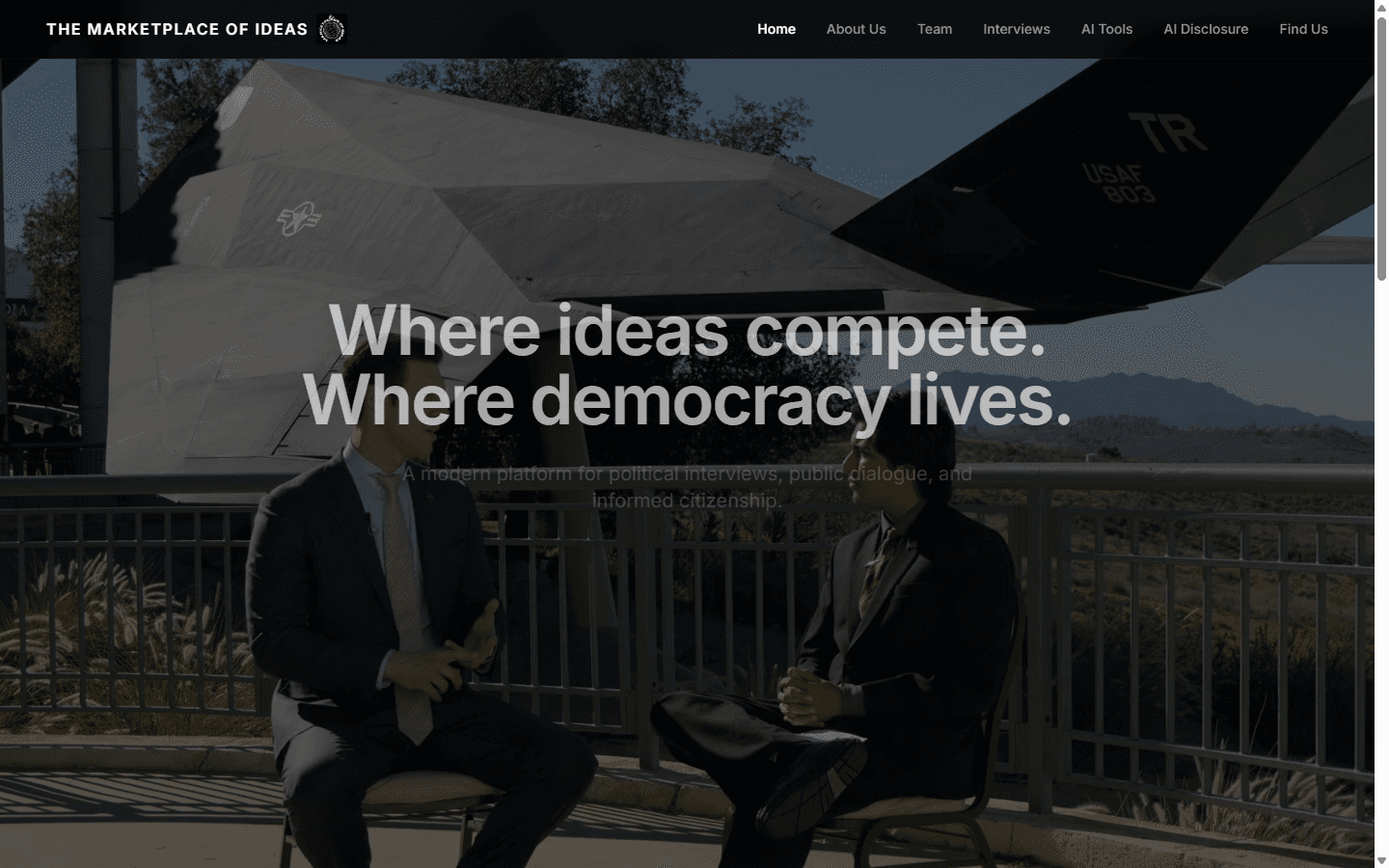
Eight episodes are public. Each interview shows the guest, the title, the date, a California or National scope, and the video, and each one has a stable URL. A reader can open the conversation itself.
The publishing rule
A record is public only when it is both approved and published. Drafts and internal notes stay out of the production bundle, so the archive contains only what we have decided to stand behind.
The other interviews
The other interviews stay available with their existing titles, dates, guests, and videos. Further quotations from those conversations remain in review. I refused to publish a quotation we had not matched to the caption for the correct video.
The role on the page
The role shown with a guest is the role stated on that interview. On Adam Smith’s page it says U.S. Congressman. That line is not a check of anyone’s current office.
Defense and California
Topic pages for defense and California gather the interviews that touch those subjects. A topic page does not mean every guest was asked the same question. On the live site those pages can still be loading the transcripts.
Standards, corrections, and reports
I drafted a standards page and a corrections log that lists only recorded corrections. Error reports go to a private path and are not published.
Model readings
Model features still appear on some pages: a briefing, notable moments, and a confidence label. Those are model readings. They are not reviewed editorial text, and the confidence label is not a truth rating.
03 · A checked quotation
Adam Smith
Adam Smith’s National Defense interview is the first place I published a quotation checked against the caption export for that YouTube video. I matched the wording to the caption near the timestamp. I did not review the audio, and I did not review the conversation around that line.
The same page also shows a model briefing, with notable moments and a confidence label. That briefing is a model reading of the transcript. It is separate from the caption-matched quotation, and the confidence label is not a truth rating.
04 · The standard
The next interviews
The next interviews follow the same standard: approved and published, quotations matched to the caption for the correct video, and the guest’s words kept distinct from our wording.
I left a written schema, examples, and a review folder so other people can add interviews in the same format.
content/README.mdcontent/examples/interview.draft.jsoncontent/examples/guest.draft.jsoncontent/review/README.mdsrc/lib/content/schema.ts